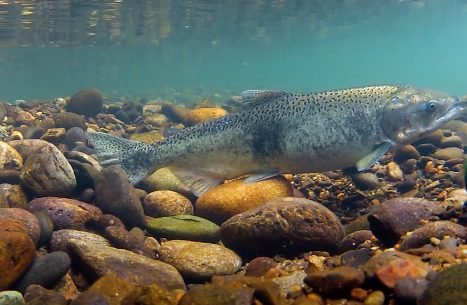
Hatchery could boost Idaho's sockeyeBellingham Herald Idaho Fish and Game and the Bonneville Power Administration recently bought a mothballed hatchery that could help recover a unique Idaho species that was nearly extinct. "This is an exciting time for sockeye recovery because we're not only seeing more returning fish than we have in a long time, but we also are seeing a commitment of resources to continue that trend," said Idaho Fish and Game Director Cal Groen. |
| Read more... |
Invasive mussels could cost $100M a year to fightThe Seattle Times The expected arrival of invasive mussels in the Columbia River Basin could cost $100 million a year to fight, according to a new report done for the Northwest Power and Conservation Council. The dime-sized freshwater mussels pose a threat to dams, irrigation systems and native fish species, said the report from a panel of economists. |
| Read more... |
Coastal salmon fishing is good-news, bad-news situationThe Statesman Journal Special regulations go into effect Sunday for anglers pursuing fall Chinook salmon on coastal rivers and streams. "This year's predicted returns for coastal fall chinook are a mixed bag," said Ron Boyce, the Oregon Department of Fish and Wildlife's Ocean Salmon/Columbia River Program manager. "We expect overall numbers to be much better than last year, but some streams on the North Coast will continue to have weak runs." |
| Read more... |
Great white shark tagged near Cape CodUPI Massachusetts wildlife officials say they've tagged their first great white shark of the year, after tagging five of the creatures in local waters last year. Using a harpoon, wildlife workers sank a tracking device into the dorsal fin of the 12-foot shark, a normally elusive creature that has been spotted more often in recent years in southern Massachusetts waters, The Boston Globe reported Thursday. |
| Read more... |
Oceans in peril: primed for mass extinction?Live Science One hundred days ago Thursday, the oil rig Deepwater Horizon began spewing oil into the Gulf of Mexico. As profoundly as the leak of millions of barrels of oil is injuring the Gulf ecosystem, it is only one of many threats to the Earth's oceans that, many experts say, could change the makeup of the oceans as we know them and wipe out a large portion of marine life. The waters of the Gulf were already heavily fished, and the Gulf has been home to an oxygen-depleted dead zone generated by agricultural runoff rich in nutrients. |
| Read more... |
UK retains Spanish vessel thought to be overfishingFIS UK authorities have held a fishing vessel, Coyo Tercero, from Ribeira, A Coruña, captive for almost 20 days. The fishermen allegedly "under-stated the number of catches" of hake, confirmed the Ministry of the Environment and Rural and Marine Affairs (MARM), reports the Europa Press. |
| Read more... |
Marine phytoplankton declining: striking global changesScience Daily A new article published in the 29 July issue of the journal Nature reveals for the first time that microscopic marine algae known as "phytoplankton" have been declining globally over the 20th century. Phytoplankton forms the basis of the marine food chain and sustains diverse assemblages of species ranging from tiny zooplankton to large marine mammals, seabirds, and fish. Says lead author Daniel Boyce, "Phytoplankton is the fuel on which marine ecosystems run. A decline of phytoplankton affects everything up the food chain, including humans." |
| Read more... |
Scientists research bacteria afflicting rockfishThe Capital It was more than a dozen years ago when Chesapeake Bay rockfish started turning up skinny and pockmarked with nasty skin lesions, and scientists are still figuring out what's going on. Scientists soon determined the culprit was mycobacteriosis, a bacterial disease. But understanding how the bacteria works - how it spreads, how it sickens the fish, how it affects the overall fish population - is a mystery that's still being unraveled. |
| Read more... |
Study overturns long-standing theory on phytoplanktonThe Columbia Basin Bulletin A new study concludes that an old, fundamental and widely accepted theory of how and why phytoplankton bloom in the oceans is incorrect. |
| Read more... |